
Prince George's People Directory Map
Prince George's County people directories answer distinct questions. Government and education directories identify public-facing staff. Deed and probate indexes list parties to recorded events. Property systems connect a known address to an owner, while business and license tools verify a public professional role. The Prince George's Room and Maryland State Archives reach into earlier generations. Choose the source by whom it lists, not merely by whether it has a search box.
| Directory | Who It Lists | Keeper | Access Route |
|---|---|---|---|
| County staff directory | Departments and named county employees | Prince George's County | Free people or category search |
| PGCPS directories | Schools, offices, and selected staff | Prince George's County Public Schools | Free school and staff pages |
| UMD directory | Faculty, staff, and sponsored affiliates | University of Maryland | Public search; student results restricted |
| Deed and probate indexes | Transaction parties, decedents, representatives | Circuit Court and Register of Wills | Free account, web notices, or office file |
| Parcel and tax directories | Owners and tax-sale account names | SDAT and County Finance | Address, parcel, or tax-sale search |
| Business and license verification | Entities, agents, and licensed professionals | SDAT and Maryland boards | Free basic public lookup |
| Historical collections | Past residents and named record subjects | Prince George's Room and State Archives | Onsite, digital, or microfilm by series |
Start with the institution when the person's public role is known. Begin with parcel sources for a known address, or historical collections for a past resident. No official, current countywide residential phone directory was located. The library may hold printed telephone books, but its official collection page does not publish exact titles or years. That gap makes a call to the local-history desk more reliable than an unsupported online claim.
Prince George's School Directories
The PGCPS Online Campus staff directory shows how a school-level directory can work. It offers a search box, a Faculty Search control, and last-name sorting. A result card may include a name, title, department or duties, institutional email, and telephone or extension. Separate PGCPS school and office directories help when the right campus or unit is known but the staff member is not.
| Search Control | Use | Result Detail |
|---|---|---|
| Search box | Enter a staff name or term | Matching directory cards |
| Faculty Search | Limit the staff view | Faculty entries at that campus |
| Last Name A-Z or Z-A | Reorder visible entries | Alphabetized staff list |
The captured directory illustrates one campus, not a promise that every PGCPS school publishes identical fields. The source image below preserves the inspected layout. It helps readers recognize staff cards and the sort controls before following the live school page.
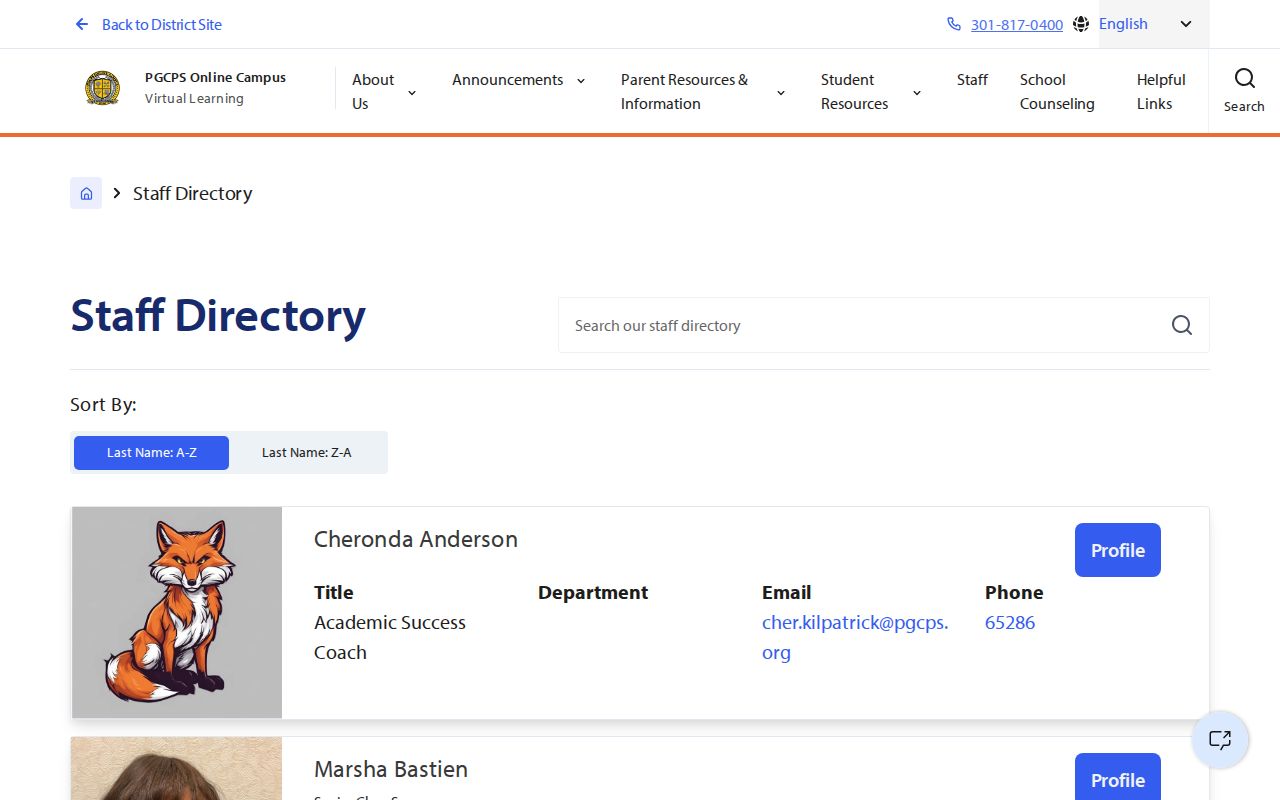
The cards identify institutional roles and contacts. They are not an alumni directory or a list of private residential details.
UMD Directory Search in Prince George's
The University of Maryland directory search accepts a first or last name and adds a “Name sounds like” option for uncertain spelling. Advanced Search provides added contact criteria. Public results for faculty, staff, and sponsored affiliates can show a name, title, unit, institutional email, phone, and office location. Student information is different: access is limited to authenticated members of the UMD community.
This distinction protects the boundary between a public institutional contact and a private student record. A building and room identify a work role, not a home. When two people share a name, compare unit, title, email domain, and office before treating the entry as a match.
The UMD contact directory route leads users to the university's official search and contact options. The captured interface shows the basic, phonetic, and advanced routes available during research.
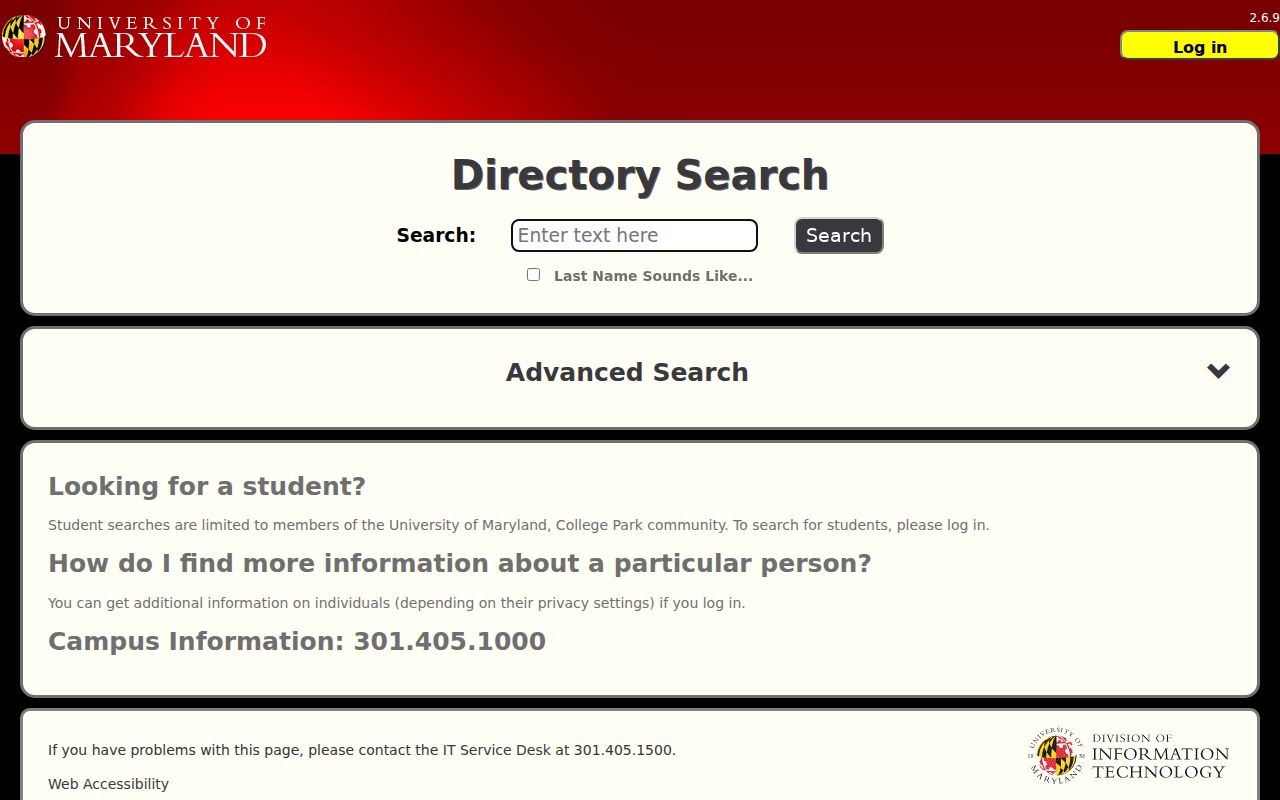
Those controls make the UMD directory especially useful when a surname spelling is uncertain, while authentication still limits student results.
Note: University directory data confirms an institutional affiliation and contact point, but it does not establish a person's private address.
Prince George's Government Directory Routes
The Prince George's County staff directory has separate Departments and People views. The department side follows a hierarchy down to nested units, which helps route a call or records question even when no employee name appears. The People view accepts a name and an optional category. Results vary, but a person entry can provide a public role, department, work phone, and linked office page.
| Name | Named employee when a People result is available |
|---|---|
| Title or role | Public function associated with the entry |
| Department | County category or nested operating unit |
| Work phone | Direct or department number when published |
| Office page | Linked department details when available |
A missing person result should lead back to the department list and main telephone number. Maryland state contacts are best found through the Maryland.gov agency directory and each agency's official contact page. Research did not verify a stable universal state employee name search, so agency routes should not be presented as one statewide phone book.
Prince George's Record-Party Directories
Some official indexes behave like people directories even though their purpose is to organize records. MdLandRec lists grantors, who transfer an interest, and grantees, who receive it. A free account opens index and scanned-book access where images are available. Prince George's County land books begin in 1696, but coverage is series-specific rather than one continuous portal date.
Probate sources add a different set of names. Register of Wills estate records can identify decedents, personal representatives, attorneys, and interested persons. Online Estate Search begins in 1998, while older estate accounts and dockets are arranged through archival series or office files. Tax-sale results expose account names for properties in that inventory. The SDAT assessment database returns an owner only after an address, account identifier, or map reference search, so it is not a browseable owner-name directory.
- Grantor
- The party transferring a recorded property interest.
- Grantee
- The party receiving that interest.
- Liber and folio
- The book and page reference for a recorded instrument.
- Situs address
- The physical parcel address, distinct from an owner's mailing address.
Voter self-lookup does not belong in this directory group. Its identity fields are designed for a voter to review their own record, not to browse unrelated people. Detailed access rules belong with the Prince George's County public records system.
Prince George's Property Owner Directories
The SDAT Real Property Data Search connects a known parcel to an owner name, mailing address, values, legal description, and sales history. It does not accept an owner name, town, neighborhood, subdivision, or ZIP as the starting query. Use the address, account identifier, or map reference. PGAtlas can help resolve parcel geography and mapped boundaries first.
County Finance's tax-sale list is a narrower owner-name-bearing directory. Results may show account name and address, district, parcel identifier, land area, legal or subdivision detail, assessed value, and tax amount. Because it covers only tax-sale inventory, it cannot stand in for a countywide owner roll. A deed also identifies legal transaction parties at a point in time, not who occupies the property today.
Address work carries a local geography trap. Postal place names, incorporated borders, and unincorporated areas do not align neatly in Prince George's County. The parcel record and municipal boundary should guide which government office or meeting archive to search next.
Prince George's Business Directory Evidence
Maryland Business Express Entity Search is an entity and resident-agent directory. A basic result can connect an organization name with status, an agent and service address, filings, and related assessment links. That address is a legal contact point. It does not prove where an owner lives or where the organization now conducts all its activity.
The captured Business Express screen below shows the official entity-search route used for Prince George's County business research. Search by the entity name, then check current status and the most recent filing date before relying on an older entry.
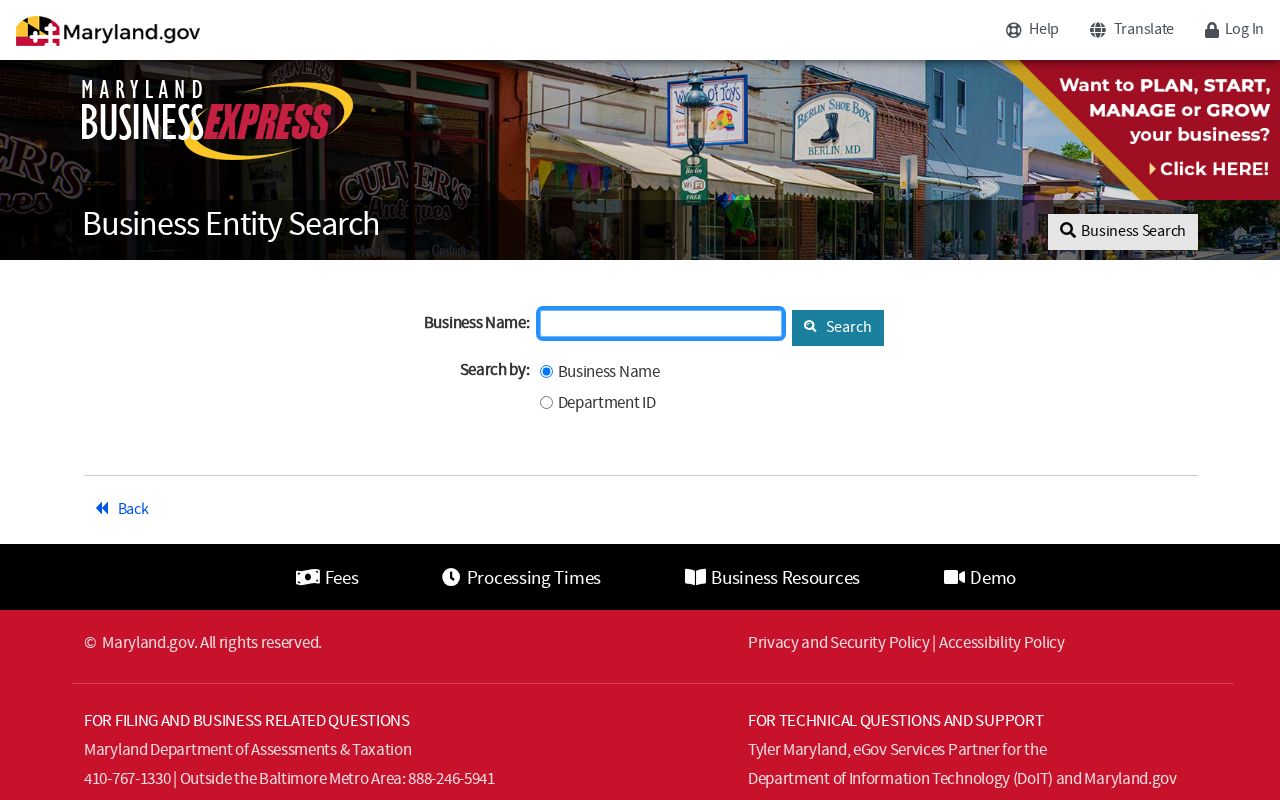
The official result is strongest when paired with a license or filing identifier, not when treated as a residential people directory.
Prince George's Professional Directories
Maryland OneStop and individual licensing boards provide current-status directories for regulated occupations. Research identified verification routes for physicians, nurses, attorneys, home-improvement contractors and salespeople, real-estate professionals, and cosmetology licensees. Judiciary tools also cover locally issued business licenses, while the county Board of License Commissioners handles local liquor licenses.
These sources answer whether the named person or business appears under a license and what public status the keeper reports. They do not prove that an old filing remains active. Match the name with a license number, board, status, and current date. Business Express can then test an associated entity or agent, but neither source alone confirms a private residence.
Historical Prince George's People Directories
The Prince George's Room at the Hyattsville Branch Library is the county's main local-history desk. Its noncirculating resources include historic newspapers, court proceedings, assessment books, Sanborn maps, county publications, journals, images, and microfilm or microfiche equipment. Staff can check whether printed city, reverse, or telephone directories cover the place and year needed. The official page does not publish an exact year-by-year shelf list.
For a former classmate or relative, school yearbooks, historic newspapers, obituaries, and authorized alumni groups can bridge a gap between census years. Community, church, neighborhood, fraternal, and alumni directories are usually private or member-controlled. Public meeting minutes offer a lawful alternative when a person spoke, served on a board, or received an appointment.
| Prince George's Room | Onsite county histories, newspapers, maps, assessments, local publications, images, and reader equipment; ask staff for directory titles and years |
|---|---|
| Maryland State Archives | Series-level land, court, estate, assessment, freedom, and index records; access may be remote, search-room-only, or microfilm |
| Digital Maryland | Selected digitized local collections, including Wilfong photographs tied to county sites |
Prince George's County was created in 1696. Searches before that point move into predecessor jurisdictions, chiefly Calvert and Charles counties. County land and court runs begin in 1696, and the separate 1787–1802 recorder abstracts preserve names and property details as protection against record loss. Later electronic grantor and grantee indexes cover 1884–1992, while other series fill different spans.
Note: An archival index locates a historical record, but the originating clerk remains the source for a certified current copy.