
Which Prince George's Records Are Open
Access depends on the record, not just on whether a government office holds it. Maryland's Public Information Act, or MPIA, starts from public access to state and local agency files. Separate laws and court rules control court files, certificates, motor data, and election records. The result is a system of indexes, summaries, restricted copies, and counter files.
| Record group | Official keeper | Web access | Practical access |
|---|---|---|---|
| Deeds, liens, and recorded instruments | Circuit Court Land Records | MdLandRec; series reach back to 1696 | Free account, then clerk for plain or certified copies |
| Court cases | Maryland Judiciary and filing clerk | Statewide public summary; depth varies | Portal first, complete public file at the proper clerk |
| Property and tax | SDAT and County Finance | Parcel, tax inquiry, tax sale, and GIS systems | Free searches; assessment terminals and agency requests remain available |
| Probate | Register of Wills | Estate Search from 1998 and legal notices | Office review; call before visiting |
| Vital records | Health Department, state DVR, clerk, and Archives | Historical indexes vary | Recent copies require eligibility, ID, application, and fee |
| Custody and registry data | County Corrections and Maryland DPSCS | State locators and offender registry | County inmate information is provided by phone |
Sealed or shielded cases, juvenile and adoption matters, protected identifiers, and recent certificates are not opened merely because a requester knows a name. Voter lists also follow Election Law and COMAR, not an MPIA shortcut. A portal's lack of results may reflect coverage, spelling, remote-display limits, or the wrong custodian rather than proof that no record exists.
Note: State and county indexes are finding aids; the office copy remains the right source when authenticity or a complete file matters.
Prince George's Deed Records by Series
The Clerk of the Circuit Court records deeds, deeds of trust, liens, leases, powers of attorney, and instruments tied to land. MdLandRec provides a free-account route to county indexes and scanned books. Search both grantor and grantee roles. A grantor transfers an interest; a grantee receives it. Retain the liber and folio, the book and page citation, because that pair lets clerk staff locate an instrument with far less doubt.
Prince George's land access cannot be reduced to one coverage date. County land books begin in 1696. The Maryland State Archives land-book series covers 1696 through 1851, while the early index covers the same span. A general index covers 1840 through 1884, electronic grantor and grantee runs cover 1884 through 1992, and a separate miscellaneous index covers agreements, assignments, notices, and releases from 1966 through 1994.
- Index
- A list that points to a record by name, date, type, or citation.
- Image
- A scan of the recorded page, which may contain details absent from the index.
- Certified copy
- A copy carrying the keeper's formal certification, requested from the clerk.
- Custodian
- The office responsible for holding and responding for a record.
When the online route fails, call Land Records at 301-952-3352 or the general clerk at 301-952-3318. Give the party name, rough year, instrument type, and liber/folio if known. The courthouse counter at 14735 Main Street in Upper Marlboro is the in-person fallback. Older address and name gaps may also require Archives indexes or the Prince George's Room's assessment books and maps.
Prince George's Court Record Limits
Maryland launched its integrated Case Search and Record Portal on March 14, 2026. Public users can search computerized summaries after accepting the agreement and completing its access control. The portal covers Circuit and District Court data, with historical depth tied to local automation. Prince George's filings may belong to Circuit Court in Upper Marlboro or District Court in Upper Marlboro or Hyattsville.
| Search control | How it works | Best use |
|---|---|---|
| First name | Optional; exact by default, trailing % permits a partial | Narrow a common surname |
| Last name | Required for a person search; company name may be entered here | Start a party search |
| Court or location | Optional jurisdiction filter | Route a later copy request |
| Case type and filing dates | Optional narrowing filters | Stay below the 500-result cap |
| Case number | Direct route when known | Reduce mistaken identity |
A result may identify parties, roles, city and state, case number, filing date, attorneys, charges, dispositions, and docket events. It may not provide document images. Some dismissed, acquitted, nolle prosequi, or older stet charges are removed from remote display yet can remain open at the courthouse. Contact the clerk named in the result for the complete public file. Court records follow Maryland Rules 16-901 and later provisions rather than an ordinary county agency request.
Note: Broad searches stop at 500 results, so add a first name, court, case type, or filing range before drawing conclusions.
Prince George's Property Record Boundaries
Three systems answer three distinct questions. SDAT Real Property Data Search holds the assessment account, owner mailing address, premise address, parcel identifiers, values, and sales history. County Finance holds the tax account and tax-sale data. The Circuit Court holds the deed that records a transfer. PGAtlas supplies the geographic view, but it is not the source to certify title.
SDAT has a notable limit: it does not accept an owner name, town, neighborhood, subdivision, or ZIP as the starting query. It accepts an address, account identifier, or map reference. Omit a street direction and suffix when an address fails. A trailing asterisk may complete a partial street name. Free public terminals at local assessment offices remain an offline channel.
The county Tax Inquiry favors the account number. Its payment processor charges are not search fees. The separate tax-sale list can show an account name and address, parcel, district, land area, legal description, assessed value, and taxes. That name-bearing list helps only for the current sale inventory. Confirm any result against SDAT and the deed because billing data may lag or identify a mailing role.
Prince George's Public Records Offices
Custody follows the office's work. The Circuit Court clerk spans land, cases, locally held marriage records, and business licenses. Probate files belong to the Register of Wills. Birth and death certificates have both a local Health Department route and a statewide Division of Vital Records route. Use the filing location or record type before choosing a counter.
Local Vital Records
3003 Hospital Drive, Room 0025
Cheverly, MD
301-324-2940
The Circuit Court directory lists weekday hours from 8:30 a.m. to 4:30 p.m., except legal holidays. The Register does not accept email filings, recommends calling first, and requires appointments for New Estates and Auditing. Local vital service is appointment-only on Monday, Tuesday, Thursday, and Friday mornings. Check current notices before travel.
Prince George's Vital Record Access
Recent certificates are restricted products, not open name indexes. Prince George's Health Department issues local birth and death certificates to eligible applicants by appointment. The local fee documented in the research is $25, with cash, money order, or card accepted and a separate $2.50 card fee. Maryland's Division of Vital Records also handles birth and death orders, post-2007 marriage certificates, and divorce verification under its own application rules.
A birth applicant may be the registrant, a named parent, a court-appointed guardian, a surviving spouse, or an authorized representative with notarized permission. Mail orders require the current form, payment, identification copy, and a self-addressed envelope. Marriage certificates for events before 2007 move to the Circuit Court or Maryland State Archives, depending on year. Divorce verification from vital statistics is not the court decree.
The Archives separates historical indexes from record copies. Marriage records from 1951 through 1981 are at the Archives; 1982 through 2006 files are off-site and should be requested seven to ten business days ahead. The event year and product sought must be clear before selecting an office.
The Maryland birth-record service shows the eligibility route used for Prince George's County public records.
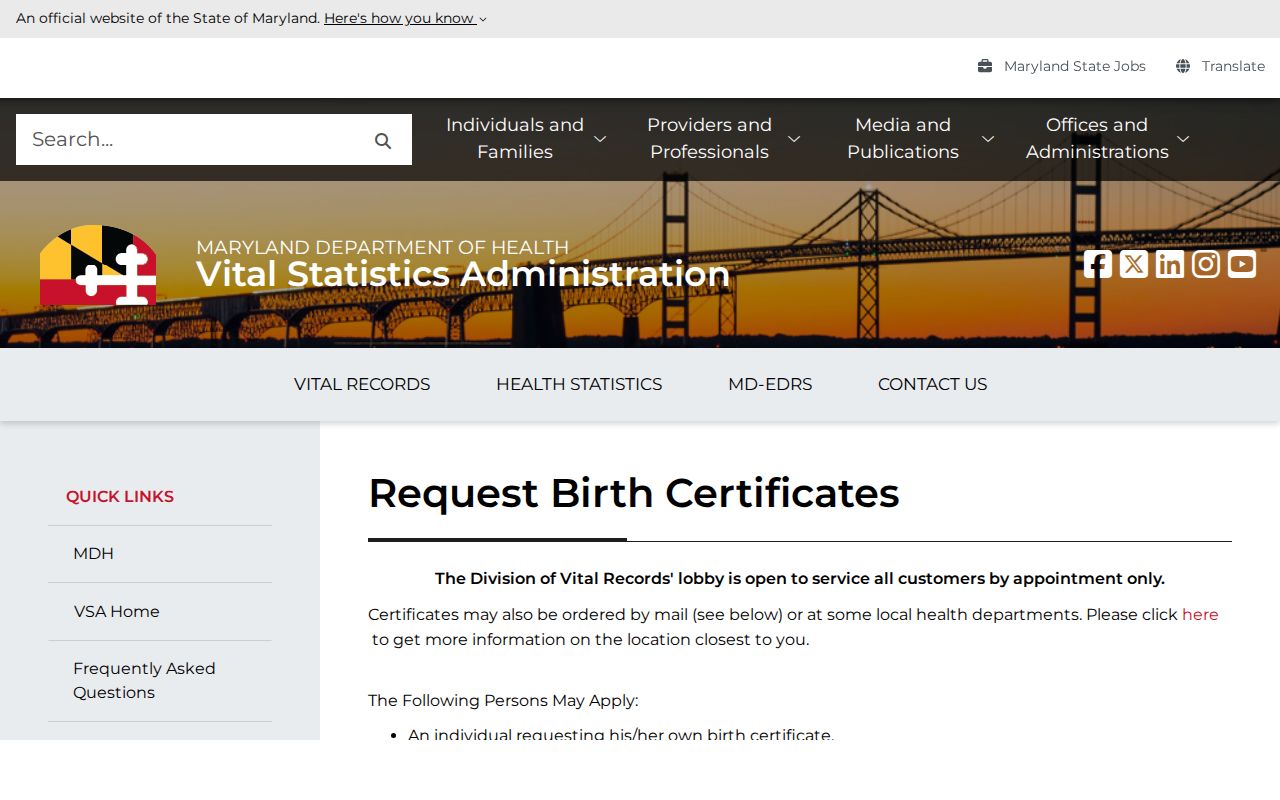
The application links and proof rules show why a historical index hit and a certified current certificate are not interchangeable.
Prince George's Custody Record Channels
County custody information does not come from a browsable web roster. The official county Inmate Locator page directs callers to 301-952-7164 or 301-952-7025. Maryland DPSCS provides a statewide incarcerated-individual locator, while the federal Bureau of Prisons has a separate locator for federal custody. These systems cover different facilities and should not be treated as one list.
The Maryland Sex Offender Registry supports name and area searches and optional distance alerts. Results can include a name, photo, reported residence or work location, and registration data. The registry warns that data is time-sensitive and self-reported, and a blank ZIP result does not prove that no registrant is present. Fingerprints are required for positive identity.
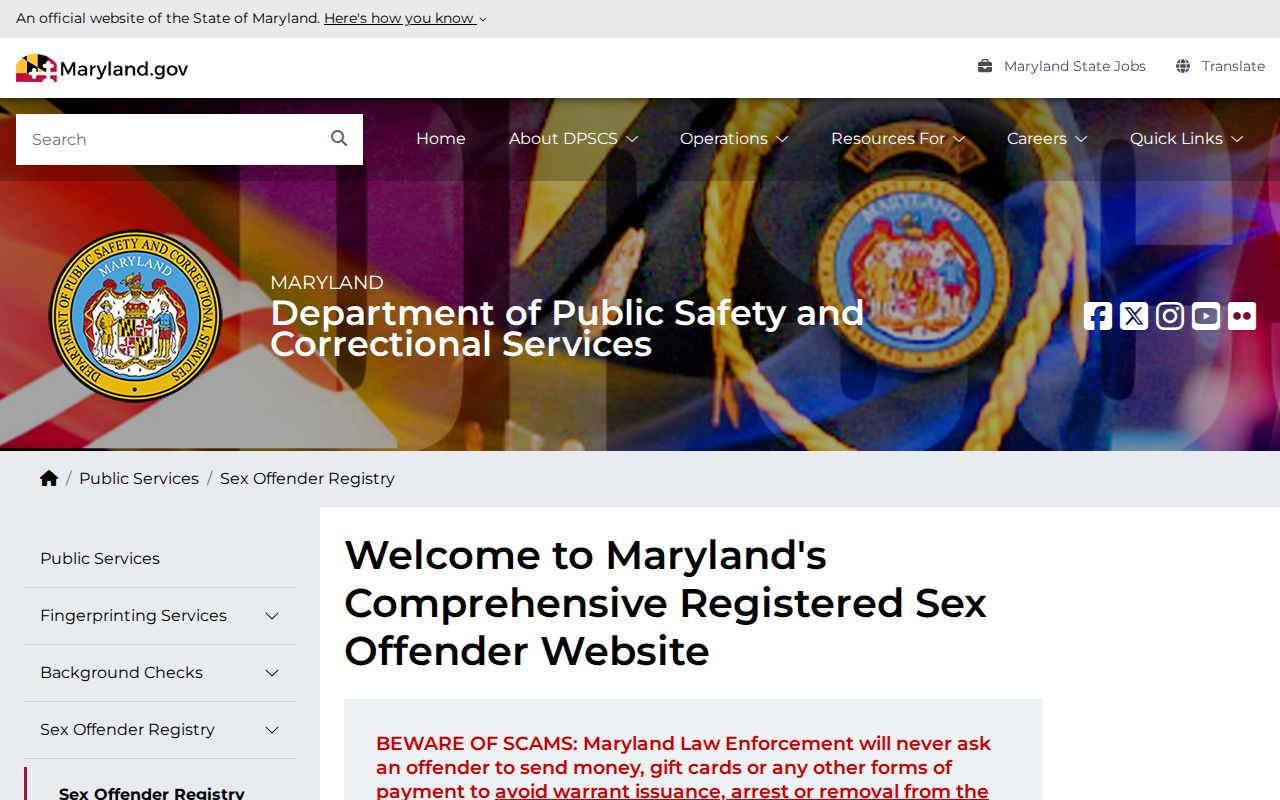
The registry's warning matters as much as its search controls: verify identity through the responsible agency and never use a record to threaten or harass someone.
Lawful personal use. Maryland public access is not permission to stalk, harass, injure, intimidate, or commit fraud. Registry misuse may lead to prosecution.
Prince George's Permit Record Requests
DPIE separates search from copy access. Its Legacy ePermit tools show permits, address-based permit history, status, and inspection history. LookSee covers Momentum permits, licenses, inspections, and enforcement through a full application or permit number or a property address. The App Tracker needs a specific application number. A visible status does not mean the permit copy or signed plan is downloadable.
Search the free systems first. Then use the DPIE MPIA form for a copy. The form asks for a case or activity number, copy count, property address, and a clear account of the information sought. Signed or sealed plan requests need added design-professional details. Applicant fields include name, email, address, phone, signature, and date; company is optional when it does not apply.
DPIE accepts the form at DPIE.MPIA@co.pg.md.us and states that processing may take up to 30 days. Official web and PDF sources show different agency addresses after organizational moves, so electronic submission is safer than assuming a walk-in location. The form's Approved or Denied section, activity number, and amount fields are for staff, not the requester.
Note: A narrow property address, date span, permit number, and requested format reduce search time and help the custodian quote any cost.
Privacy Limits on Prince George's Records
Public status does not erase privacy rules. Maryland Safe at Home gives eligible threatened people a substitute address and mail forwarding. Courts restrict defined identifiers and sensitive case types. The federal Driver's Privacy Protection Act and Maryland law limit motor-vehicle personal data. Agencies may redact protected material even when the rest of a file is open.
Maryland's Online Data Privacy Act took effect for covered processing beginning October 1, 2025. It provides access, correction, deletion, portability, and sale or targeted-ad opt-out rights within its scope and exceptions. Those commercial-data rights do not usually erase a lawful deed, docket, assessment, or other government record. Corrections to an official record must follow the keeper's law and procedure.
Use two independent points to distinguish names, such as a middle initial plus event date, or an address plus case number. A deed identifies transaction parties at a past date. A tax mailing address may belong to a fiduciary or management firm. State clearly that a portal did not return a result under certain inputs instead of claiming no record exists.
Request Prince George's Public Records
Any person may request agency records under the MPIA. Prince George's County publishes a department-by-department custodian directory, not one inbox for all files. If the office cannot provide a record promptly, it ordinarily must respond within 30 days and send a notice within ten working days that explains the delay, estimated completion, and cost.
- Choose the right keeper. Use the county list for executive agencies. Send judicial files to the proper clerk and restricted certificate requests to the vital-record authority.
- Check free access first. Search the official index, permit tool, or parcel system and retain any case, account, permit, liber, or folio number.
- Describe an existing record. Give names, addresses, record type, and a focused date range. Ask for electronic inspection before certified paper when that meets the need.
- Set cost terms. Ask for an estimate, a fee waiver when justified, rolling production, and notice before work exceeds a stated limit.
- Keep the response trail. Save proof of submission. A denial should cite its reason, legal authority, and review rights.
Reasonable copying and search or preparation costs may apply, but the first two hours of search and preparation are free. A model Maryland fee schedule illustrates standard-copy and certification charges, but it does not replace a custodian's record-specific statute or current schedule. Ask the actual office for a quote.
If a denial or delay cannot be resolved by narrowing or clarification, a requester may seek help from the Public Access Ombudsman. Where jurisdiction exists, the PIA Compliance Board is another route, followed by judicial review. An agency need not create a custom answer or perform genealogy; request a defined file that it already keeps.